 Changenow
Changenow Pro limit-order changes and balance conversions
Updated:Changenow Pro limit orders cannot be edited after creation; changing their conditions requires cancelling the existing order and creating a replacement order. These instructions apply to custodial balance-to-balance conversions, where selected funds remain reserved while an order is active. A replacement has its own conditions and execution uncertainty. Cancellation releases the unconverted reserved amount without reversing any completed conversion. Available liquidity and the execution provider’s technical availability still govern any new order.
Reserved balances and target-price instructions
A balance-based limit order connects the selected asset amount to a price condition for conversion into another asset. Only the selected amount enters this reservation. Reserved funds remain unavailable for manual conversion or withdrawal while the instruction is active. This makes the available balance important when considering a change: an account total can include funds already committed to an order.
Pro balance services use third-party custody. The account interface presents the conversion controls, while the custody arrangement determines access to deposited assets. A balance entry is therefore different from assets under an external wallet’s direct control.
Conditional execution or an immediate conversion
Limit, Market and Fixed are different order choices in the Pro conversion interface, so a replacement need not preserve the previous mode. The choice determines whether conversion waits for a target price or uses an immediately available quotation. Availability of a mode for the selected assets remains relevant; a general asset listing does not establish support for every order type.
Keeping a price-conditioned conversion
A Limit instruction retains a chosen price condition and can remain unfilled when suitable liquidity never becomes available. This mode suits a conversion whose acceptable rate matters more than immediate completion. Setting the condition avoids repeated manual price checking, although it leaves the requested exchange dependent on future market conditions.
Using an immediate conversion
Market orders
Market mode requests conversion at the prevailing market rate without waiting for a separately chosen target. For the same pair and quotation direction, compare the quoted rate with the original target rate. Check the quoted output for the replacement amount.
Fixed orders
Fixed mode uses a locked quotation for immediate conversion rather than waiting for the market to reach a future target. This option does not provide an editing control for an active Limit instruction or carry its earlier target into a new quote.
Can an active Pro limit order be edited?
Changing an existing Pro limit order requires cancellation and a new order.
Keeping an order or replacing its conditions
The supported choices are to leave a suitable order active or cancel it before creating a replacement. Both depend on an eligible custodial balance and a supported pair. Judge the choice by whether the existing conditions still match the intended conversion. An outdated target is a reason to change the instruction. A cancellation error leaves the original order’s state unresolved.
- Confirm the account has the custodial balance the limit-order feature requires.
- Check any completed conversion before deciding how much remains available for a replacement.
- Keep the active order only if its selected assets, target rate and remaining duration still suit the intended exchange.
- For a change, confirm cancellation and release of the unconverted reserved funds before committing them again.
- Review the replacement’s asset direction, amount and order type. For Limit mode, also check its target rate and duration. Submit the replacement and confirm its status in the account.
If cancellation encounters a technical error, resolve the original order’s state before retrying. A submitted cancellation request alone does not confirm released funds.
Unconverted amounts after partial execution
A partial execution converts only part of the requested amount, leaving a remainder subject to the order’s conditions. Further execution can occur if those conditions become executable again while the order remains active. Cancelling the remainder does not undo the completed conversion. For a replacement of the unfinished portion, the relevant amount is the remaining starting asset.
The acquired asset and the unconverted remainder are different balances. Their raw asset quantities do not describe a single remaining order amount.
Available pairs, target ranges and order duration
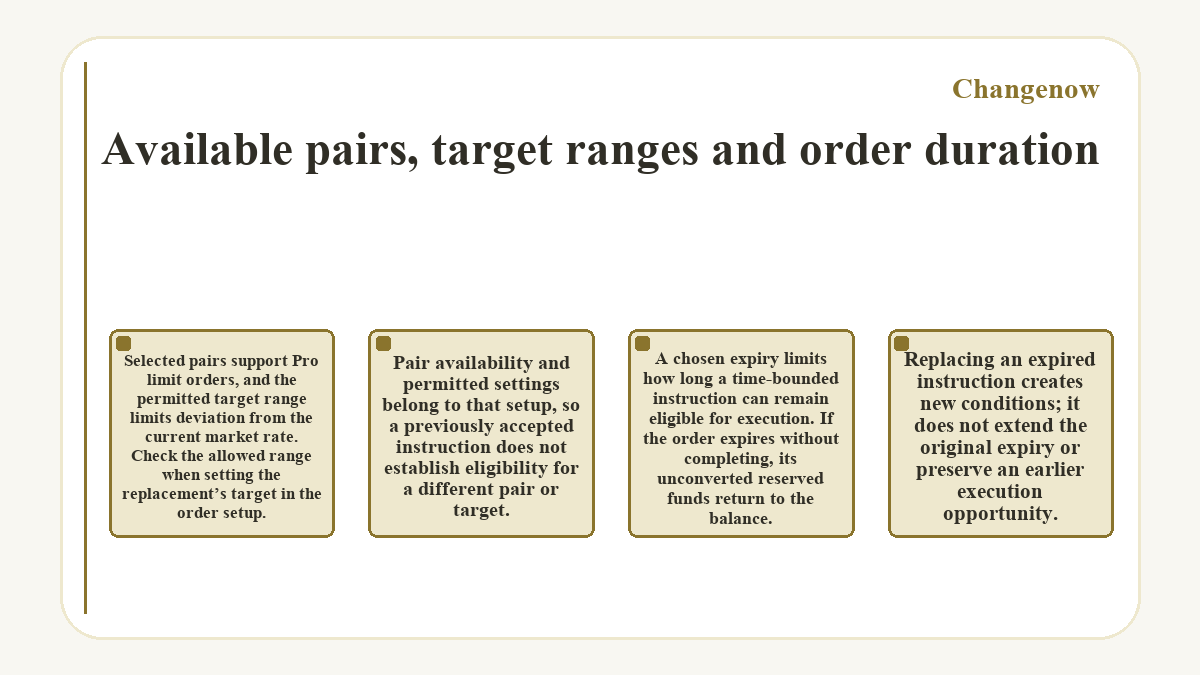
Selected pairs support Pro limit orders, and the permitted target range limits deviation from the current market rate. Check the allowed range when setting the replacement’s target in the order setup. Pair availability and permitted settings belong to that setup, so a previously accepted instruction does not establish eligibility for a different pair or target.
A chosen expiry limits how long a time-bounded instruction can remain eligible for execution. If the order expires without completing, its unconverted reserved funds return to the balance. Replacing an expired instruction creates new conditions; it does not extend the original expiry or preserve an earlier execution opportunity.
Liquidity and the third-party execution service
Third-party service providers execute Pro limit instructions, and their terms govern the resulting transactions. Market conditions and technical availability can prevent execution even when a displayed price reaches the selected level. An acceptable quotation alone does not establish enough executable liquidity for the full amount. This explains why a price condition can coincide with partial execution or no conversion.
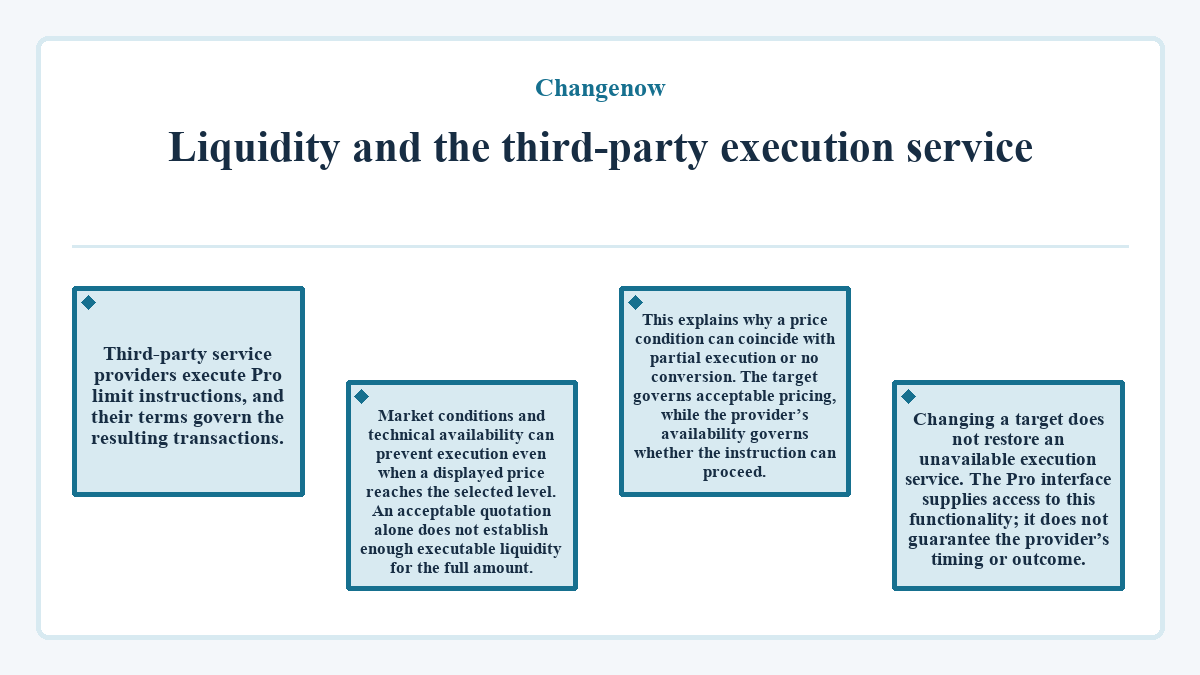
The target governs acceptable pricing, while the provider’s availability governs whether the instruction can proceed. Changing a target does not restore an unavailable execution service. The Pro interface supplies access to this functionality; it does not guarantee the provider’s timing or outcome.
Cancellation errors and account records
Technical problems can prevent normal execution or cancellation and sometimes require support intervention. An unresolved cancellation leaves uncertainty about the active instruction and its reservation. Useful details include the affected order, its visible state and the error displayed during cancellation. Account access credentials should remain private when discussing the problem.
Pro transaction history provides records of exchange activity, with searches by transaction ID, wallet address or transaction hash. It also supports PDF and CSV exports. These records help reconcile related activity, although an off-chain balance conversion need not produce a new blockchain transfer for each partial execution.
Withdrawal after releasing a balance reservation
Released funds become available in the balance; sending them to an external wallet requires a separate withdrawal.
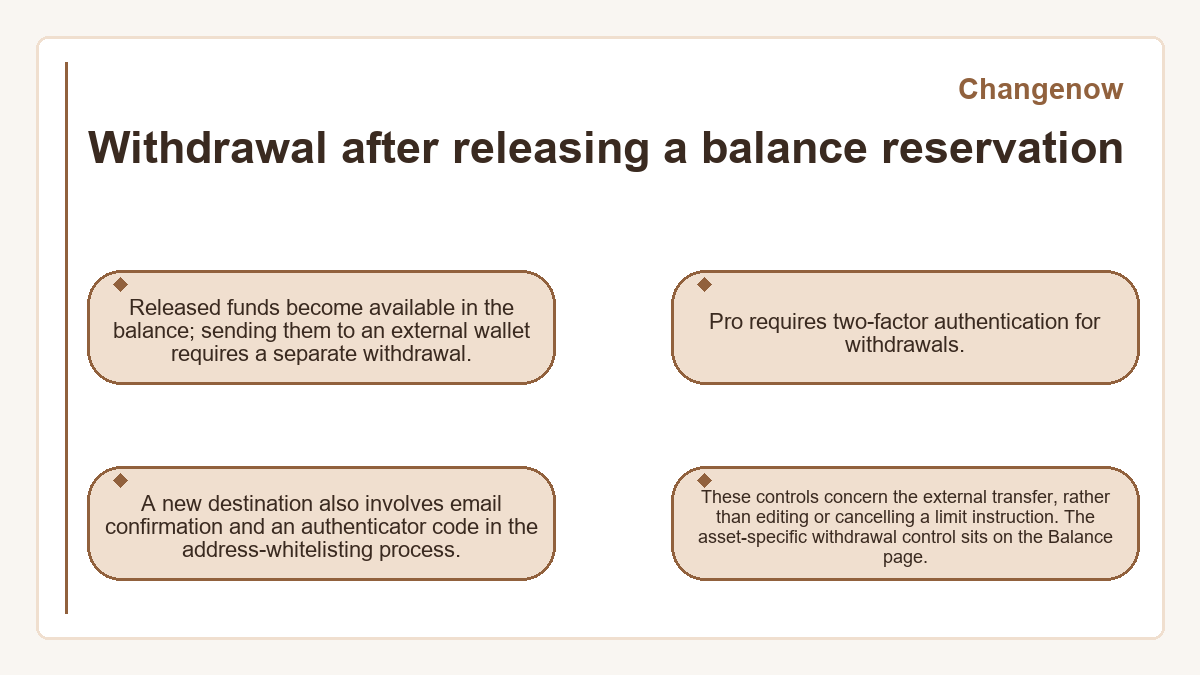
Pro requires two-factor authentication for withdrawals. A new destination also involves email confirmation and an authenticator code in the address-whitelisting process. These controls concern the external transfer, rather than editing or cancelling a limit instruction. The asset-specific withdrawal control sits on the Balance page.
Helpful answers about Changenow
Can a Web3 wallet connection alone provide access to Pro balance limit orders?
A wallet-only connection without a linked email does not create the custodial account this balance-based feature requires. Connecting a wallet and having an eligible account balance are different conditions; the connection alone cannot supply funds the service can reserve for a limit instruction.
Are Pro limit orders available in the Android app?
The Android app supports setting target rates and managing active Pro limit orders. Mobile access retains the balance-based feature’s account requirements. Managing an order from a phone does not change its conversion scope or give it a separate editing capability.
What does reversing the rate quotation change when preparing a replacement order?
Reversing the quotation displays the selected pair’s price in the opposite direction. Read the rate together with the assets selected for selling and buying, because reciprocal quotations use different units. The quotation direction describes the price; it does not itself change the intended conversion.
How do exchange fees appear in a Pro replacement conversion quote?
The Pro conversion interface includes exchange fees in the displayed rate. Compare the actual quotation for the selected assets, rather than treating the previous target rate as an available execution price.
When can delisting change the treatment of an active Pro limit order?
Delisting an asset or pair automatically rejects an active balance-conversion limit order. Its unconverted remainder follows the applicable refund or conversion process, which differs from ordinary manual cancellation. Affected balances may convert into a stable asset, so return of the original asset is not assured.
Does email verification complete identity checks for a Pro limit-order account?
Email verification confirms access to the registered email and does not complete Know Your Customer (KYC) identification. Pro treats identity verification as a separate procedure. Its default account setup does not require KYC, although individual services and transactions can remain subject to applicable access and compliance requirements.